
Lego Club: STEM Activities at School


Those colorful interlocking bricks we all know and love have become powerful educational tools in classrooms across America. STEM activities using these familiar building elements create engaging learning environments. Students develop critical skills while having fun.
When children participate in a LEGO® club, they’re not just playing—they’re developing essential science, technology, engineering, and mathematics skills. The hands-on nature of building with bricks provides students with tangible ways to understand abstract concepts. Textbooks alone cannot convey these ideas.

What makes these brick-based educational programs so effective is their ability to blend creativity with academic learning. Students of all ages can participate in LEGO® Education competitions that challenge them to solve real-world problems through design and innovation. These activities create an inclusive environment where every child can contribute their unique perspective.
The growing popularity of these building programs in educational settings isn’t surprising. They offer a perfect balance of structured learning and creative exploration. This makes STEM accessible and exciting for students who might find these subjects intimidating.
Key Takeaways
- Brick-based activities make abstract STEM concepts tangible and accessible
- Students develop critical thinking and problem-solving skills through hands-on building
- Educational building clubs create inclusive environments for diverse learning styles
- STEAM integration helps bridge creativity with technical skills
- Classroom engagement increases when learning involves interactive construction
- Building activities prepare students for future careers requiring collaboration and innovation
The Value of Lego Clubs for Schools in STEM Education
Schools with LEGO clubs find a wealth of educational benefits. These colorful bricks turn abstract ideas into real learning chances. Students dive into complex topics with excitement, gaining skills for the future.
LEGO activities are more than fun; they’re a start to deep STEM knowledge. Connecting bricks opens doors to engineering, math, and science. It’s a way to learn that textbooks can’t match.
LEGO clubs are special because they boost many skills while keeping learning fun. Let’s look at how these clubs help STEM programs in schools.
Building Critical Thinking and Problem-Solving Skills
LEGO challenges make students think deeply. Problem-solving becomes natural as they solve design problems. For example, building a bridge that holds weight teaches engineering and trial and error.
LEGO learning gets more complex naturally. Students learn to:
- Analyze problems from different sides
- Test ideas through hands-on experiments
- Improve their plans based on results
- Keep trying when things don’t work out
This cycle of design, test, and improve is like what engineers and scientists do. When a project fails, students see it as a chance to learn and do better next time.
“The most valuable skill we see developing in our LEGO club is the ability to view failure as information rather than defeat. Students learn that each unsuccessful attempt provides crucial data for their next design.”
Elementary STEM Coordinator
Fostering Teamwork and Collaboration
LEGO clubs are great for teamwork. Students must talk and work together to reach goals. They learn the value of different views and skills.
Students develop teamwork skills by working on tough projects. They learn to:
- Share ideas clearly and listen to others
- Assign tasks based on who’s best at them
- Find common ground when opinions differ
- Enjoy their wins together
These social skills help students in many areas. Even shy math whizzes and outgoing artists can work well together. They find success when they combine their strengths on robotics projects.
Hands-On Learning of STEM Concepts
LEGO clubs make STEM concepts real and easy to understand. Hands-on learning turns theory into something students can touch and feel.
Math becomes exciting when students work with ratios, measure, or explore symmetry. Science comes alive with experiments on balance, friction, and simple machines. Technology and engineering blend as students move to motorized builds and programming.
Examples of STEM concepts learned through LEGO include:
| STEM Area | Concept | LEGO Activity | Learning Outcome |
|---|---|---|---|
| Science | Structural Stability | Tower Building Challenge | Understanding center of gravity and base support |
| Technology | Programming Logic | LEGO Robotics Sequence | Developing algorithmic thinking |
| Engineering | Simple Machines | Creating Working Pulleys | Applying mechanical advantage principles |
| Mathematics | Geometry | Symmetrical Structure Design | Visualizing spatial relationships |
Students often don’t see they’re learning complex ideas. They’re just playing with a purpose. This hands-on STEM learning makes learning stick better than traditional methods.
By adding LEGO to STEM programs, schools give students a special mix of creativity and structure. Students grow their imagination and analytical skills. This prepares them for challenges that need both creativity and logic.
The skills gained in LEGO clubs are a strong base for lifelong learning. They go beyond the classroom, helping students in many ways.
How to Start and Run a Successful Lego Club
Ready to boost your school’s STEM program with LEGO bricks? Starting a LEGO club is simpler than you think! We’ve got all the info you need to kick off this exciting journey. It will engage students in hands-on learning and build important skills for their future.
Essential Materials and Budget Planning
Building a great LEGO collection doesn’t have to cost a lot. Start with basic sets that work for many projects and ages. LEGO Classic sets are great for young kids, while older students can use Technic or Architecture sets.
Storage is key, not just the bricks. Organized storage systems keep pieces in order and save money. Use clear bins sorted by type, color, or function for easy access.

- Organize a LEGO donation drive
- Look for sponsorships from local businesses
- Apply for STEM education grants
- Have students bring their own LEGO for some meetings
Start small and grow your collection as interest grows. Even a few bricks can spark creativity in eager hands!
Structuring Club Meetings and Activities
Good LEGO clubs have a clear plan and fun challenges. Meet for 60-90 minutes with a mix of building and new ideas. Start with a quick show-and-tell or ice-breaker.
Focus on building challenges that match each age group’s skills. Younger kids might build a bridge, while older ones tackle more complex projects like a working elevator.
Here’s a meeting plan that works well:
- Welcome and intro (5 minutes)
- Warm-up challenge (10 minutes)
- Main building activity (30-45 minutes)
- Sharing and feedback (10 minutes)
- Clean-up and next meeting preview (5 minutes)
Show off student work on a Facebook page or in the hallway. This builds excitement and attracts new members. Host mini-exhibitions at semester’s end to show off student achievements.
Incorporating Robotics and Coding Challenges
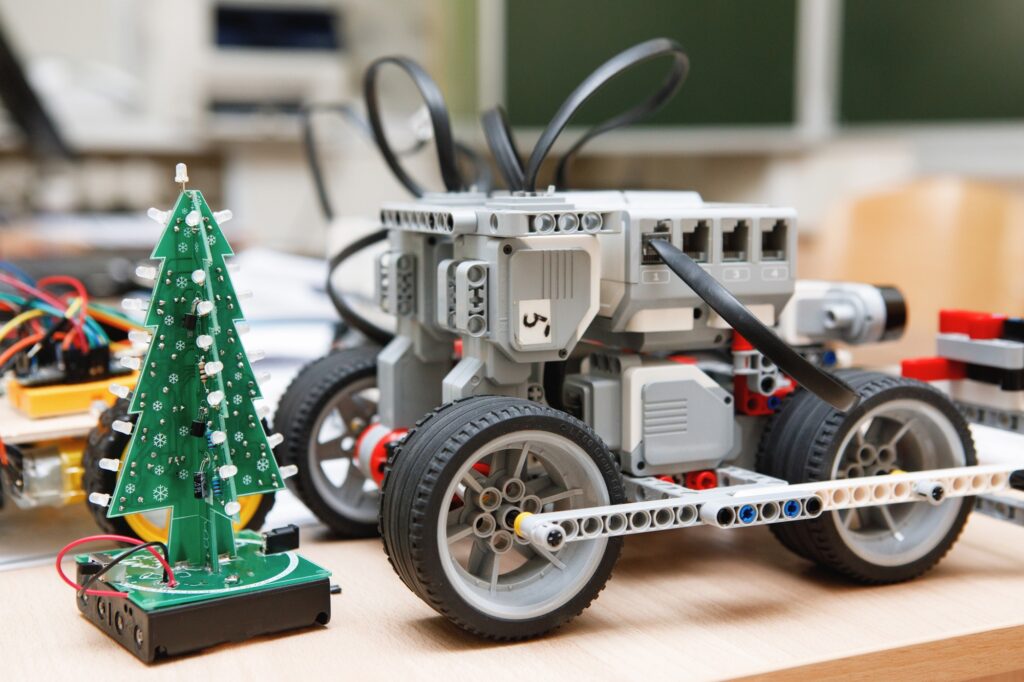
Once your club gets the hang of building, add robotics and coding. LEGO Education has options that grow with your students. Start with simple builds that teach physics before moving to programmable sets.
Try these LEGO STEM activities that mix coding with building:
- LEGO Zip Line: Learn about slopes, tension, and gravity
- LEGO Catapult: Build simple machines to show force and motion
- Binary Code Builders: Teach coding basics with colored bricks
For older students, LEGO Mindstorms or SPIKE Prime sets offer advanced tools. These platforms let students program and experiment with real-world challenges.
LEGO coding makes complex ideas easy to grasp. Students see how their code changes their creations, making learning fun and hands-on.
Participating in FIRST LEGO League Competitions
Competitions can boost your club’s skills and interest. The FIRST LEGO League (FLL) is a global program that challenges teams to solve real problems with LEGO robots.
FLL has divisions for different age groups:
- FIRST LEGO League Discover (ages 4-6)
- FIRST LEGO League Explore (ages 6-10)
- FIRST LEGO League Challenge (ages 9-16)
Registration opens in May for the next year. Teams get a kit with materials and instructions for that season’s theme, often focusing on science or social issues.
Students learn to solve real problems as they build and present their solutions. They develop important skills like teamwork, perseverance, and creativity, helping them in all subjects.
For competition, practice more and get mentors. Many teams keep detailed notebooks of their design process. This is key for judging.
Whether your LEGO club competes or not, it will inspire future innovators and problem solvers. The colorful bricks become tools for developing tomorrow’s STEM leaders.
Conclusion
LEGO goes from simple bricks to powerful learning tools. Starting a LEGO club at school builds more than just structures. It creates lasting learning habits.
LEGO education works for all ages. Young kids start with basic fun, while older students dive into robotics and coding. This keeps them excited and learning every year.
LEGO clubs are unique because they help students who struggle in class. The colorful bricks make learning fun for everyone. Every child can find their way to understanding STEM.
Being part of a global robotics program like FIRST LEGO League is even more exciting. Students build robots and solve real-world problems. They learn skills that books can’t teach.
Are you ready to start your LEGO adventure? Begin with a small set and a few students. As more join, your club can grow. The key is to start. Your students are eager to find their inner engineers and scientists through LEGO.
Q: What is the purpose of starting a Lego club in school?
A: Starting a Lego club in school encourages children ages 5-14 to engage in STEM activities through exploration and hands-on learning using LEGO® bricks. It fosters creativity, teamwork, and problem-solving skills.
Q: How can I get started with a Lego club at my school?
A: To get started with a Lego club, gather interested participants, secure a space for meetings, and create a schedule. You can also reach out to local businesses for donations of LEGO® bricks or funds to support the club’s activities.
Q: What types of activities can we include in our Lego club?
A: Activities can include building challenges, engineering projects, show and tell sessions, and competitions. Incorporating themes like robotics or architecture can enhance the educational experience using LEGO education solutions.
Q: Is there a specific age group that should participate in a Lego club?
A: A Lego club can cater to children ages 5-14, but you can also create programs for secondary school students that focus on more complex engineering and design challenges using LEGO® bricks.
Q: How does participating in a Lego club benefit students?
A: Participants gain real-world problem-solving experiences, develop critical thinking skills, and learn the habits of learning through collaborative projects and exploration with LEGO® bricks.
Q: Can I bring my own Legos to the club?
A: Yes, encouraging members to bring their own Legos can enhance creativity and allow for a wider variety of building options. It also fosters a sense of ownership and personal investment in the club.
Q: Are there any formal guides for running a Lego club?
A: Yes, there are several guides available online that provide structure and ideas for running a successful Lego club. These guides often include tips on organizing activities, managing group dynamics, and incorporating educational standards.
Q: How can we showcase our projects from the Lego club?
A: You can organize a “show and tell” event where club members present their completed projects. This can be open to the school community, allowing others to see the creativity and engineering solutions developed by the participants.
Q: What resources are available for Lego club leaders?
A: There are numerous resources available, including websites dedicated to LEGO education, forums for club leaders, and community groups where you can share ideas and best practices for running school programs effectively.




Responses